For businesses that utilize subcontractors, Contractor General Liability (CGL) insurance is an absolute necessity. If a subcontractor hired by your client’s business causes damage, your client’s business can be on the hook for financial compensation to the injured party – this is where CGL insurance comes in.
CGL insurance coverage protects your client’s business against risk if the following considerations are taken into account:
1. Is the worker an employee or an independent contractor?
Determining the status of the business’ workers is critical for measuring risk and exposure.
The IRS has a guide to help businesses assess the employee vs contractor status of their staff.
Generally speaking, common law rules to determine the status of a contractor are centered around three areas of control and independence: behavioral, financial, and the nature of the relationship.
- Behavioral: What degree of control does the company have over the worker?
- Financial: Does the payer handle the “business” aspects of the job? This includes payment methods, expense reimbursements, tax deductions, and provision of equipment.
- Nature of the Relationship: Does the worker receive benefits? Is the working relationship long-term or only for the duration of a certain project? Does the scope of the work extend to all aspects of the business or just a particular function?
According to the IRS, “There is no ‘magic’ or set number of factors that makes the worker an employee or an independent contractor, and no one factor stands alone in making this determination. The key is to look at the entire relationship, consider the degree or extent of the right to direct and control, and finally, to document each of the factors used in coming up with the determination.”
Businesses must be careful to ensure all workers are properly classified and CGL policies typically have a warranty requiring subcontractors be listed and properly classified.
2. Ensure subcontractors have equal CGL coverage to the general contractor and include the general contractor in that coverage.
Contracts between the client and the subcontractor require subcontractors carry equal CGL limits and name the client as “Additional Insured” on the subcontractor’s policy.
If those requirements aren’t met, the claim can be denied and/or the payouts reduced to lower limits.
CGL Insurance coverage at the subcontractor level ensures there is necessary coverage at all levels to meet financial obligations in the event of an accident.
3. Collect and confirm certificates of additional insured status and equal CGL limits from subcontractors.
Make sure your clients collect insurance certificates at the subcontractor level. When they receive the certificate, don’t just take it at face value.
Advise your client to call and verify the subcontractor’s coverage before paying or allowing them onto the job site.
Most state laws don’t require a policyholder to notify their additional insured before the policy is cancelled for non payment, so a subcontractor can show proof of coverage and then two weeks later cancel the policy.
It’s important to verify throughout the relationship that the policy has remained in place.
4. Jencap offers peace of mind with policies that protect your client from subcontractor liability.
We can quote with carriers that remove the Subcontractor Warranty from the policy removing the burden from your client and ensuring they are protected in cases of underinsured or uninsured subcontractors.
An audit performed with the subcontractor warranty simplifies the process for your client. The carrier would only need their financials, making the process easier for the agent and the insured.
Additionally, your client is protected in cases of fraudulent certificates from subcontractors.
For a comprehensive policy that provides your client peace of mind, get connected with one of our underwriting experts.
The Jencap Construction Insurance Team
Jencap’s construction experts specialize in a variety of construction-related coverages—from commercial general liability and professional liability to wrap-ups and workers’ compensation, and beyond. Jencap has dedicated teams of construction brokers for every risk type, account size, and geographic area in the country. We have broad market access to brokerage and binding authority and can offer exclusive program solutions to fit any construction need.
Explore Further
Jencap Announces Strategic Leadership Appointments for Construction Wrap Up Practice

Feb 6, 2024
Construction Workers’ Compensation Claims Costs on the Rise

Oct 12, 2023
Infrastructure Investment and Jobs Act and Its Impact on Insurance

Jul 13, 2023
Construction Lending Roadblocks? Consider a Surety Bond Alternative

May 24, 2023
Jencap Named Exclusive Distribution Partner for SureBuild’s Project Completion Insurance Product

Apr 25, 2023
6 Ways Agents Can Add Value to Their Contractor Clients

Mar 2, 2023
4 Things Your Client Must Know about Contractor General Liability Insurance
Jun 9, 2020
Trends & White Papers
Agent’s Guide to Professional Liability Gaps (and How to Close Them)
Professional risks are evolving faster than most coverage forms can keep up. The difference between protection and exposure often comes down to the fine print. Do you know how to read between the lines? Jencap’s professional lines specialists do, helping you see what others might miss.
The New Era of Workers' Compensation: Powered by Data, Driven by Outcomes
Cracking the CAT Modeling Code
Is Going Green Good?
Chronicles of Casualty
Navigating the New Frontiers of Professional Lines Insurance
Preparing for The Future of Cannabis Insurance
How Climate Change is Shifting the Insurance Industry
Garage Gurus: Garage Coverage Explained
Riding The Waves of Change Insurance Industry Outlook
Podcasts
Flip the Cap Episode 22: Jencap 10 Year Anniversary Edition: John Jennings on Growth, Culture, and What’s Next

Apr 7, 2026
Flip the Cap Episode 21: Global E&S Trends, Emerging Risks and 2026 Predictions
Nov 12, 2025
Flip the Cap Episode 20: The Energy Pivot: What’s Here to Stay and What’s On the Way

Aug 27, 2025
Flip the Cap Episode 19: Cannabis Insurance Insights: Regulatory Shifts, Coverage Gaps & Expert Strategies
Jul 31, 2025
Flip the Cap Episode 18: The Big Build: Inside Construction Wrap-Up Programs
Apr 24, 2025
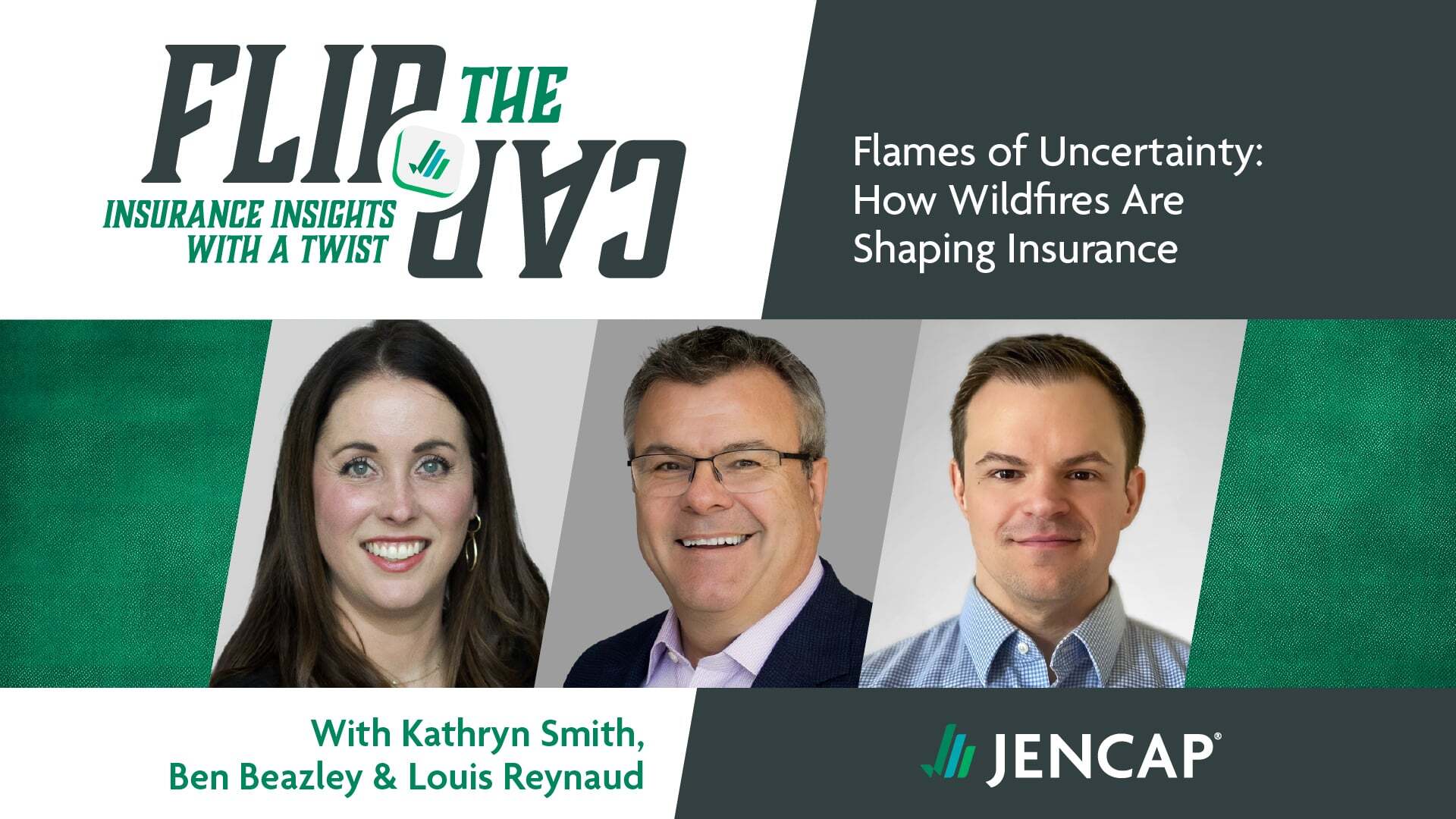
Flip the Cap Episode 17: Flames of Uncertainty: How Wildfires Are Shaping Insurance
Mar 20, 2025
Recent Posts
The Technology Signals Reshaping Transportation Risk in 2026

Apr 25, 2026
Cannabis Insurance in Newly Legalized States

Apr 14, 2026
Renewable Energy Risk Trends for Insurance Agents
Apr 9, 2026
Flip the Cap Episode 22: Jencap 10 Year Anniversary Edition: John Jennings on Growth, Culture, and What’s Next

Apr 7, 2026
Common Gaps in Watercraft & Yacht Insurance Coverage

Mar 26, 2026
PFAS Disposal Rules Shift Again
Mar 19, 2026