




Looking at insurance trends, few lines of business have been as consistently profitable as workers’ compensation. This segment has outperformed others in the U.S. property and casualty insurance industry for years, thanks to a steady decline in loss frequency, favorable reserve development, and fewer medically severe claims. With business expansion and rising job growth, the market has remained resilient despite slight pricing drops in recent quarters.
What does this mean for agents like you? Hint: it’s good. Really good. There are immense opportunities in this stable environment to grow your client base, offer innovative solutions, and reinforce your role as a trusted advisor. Let’s explore how the current market conditions and workers’ comp insurance trends create an ideal space for maximizing growth.
The Impact of Profitability on the Workers’ Comp Insurance Market
Workers’ compensation’s high profitability means more than just good news for insurers — it opens doors for you and your clients. As Kristi Tinker from Jencap explains, this could lead to insurers investing more heavily in refining their workers’ comp products. “We may see insurers put more resources into better risk management tools, more sophisticated claim processes, and cutting-edge safety programs,” she notes. Advancements translate into more value for clients, and agents who stay informed can pass those benefits directly to their customers.
Wage Growth and Job Expansion: Driving Premium Growth
Despite slight pricing decreases over the past few years, premium growth in workers’ compensation remains strong, thanks largely to wage increases and job expansion across various industries. As businesses hire more workers and wages rise, premium levels have surpassed pre-pandemic highs, creating a fertile market for agents to cultivate new clients and expand existing relationships. Keep your eye on sectors experiencing hiring surges.
Navigating a Competitive Market
While workers’ compensation is profitable, it’s also highly competitive. The top 25 insurers account for about 67% of all workers’ compensation business, leaving plenty of room for agents to carve out a niche. As Tinker highlights, “High profitability might attract more competitors, potentially increasing options for businesses seeking coverage, but also leading to market saturation over time.”
You can stand out by providing workers’ compensation policies that address the unique needs of specific industries. Adding value through risk management advice or helping clients implement safety programs further enhances an agent’s offerings.
At the same time, market conditions may be shifting. Mendy Cox from Jencap observes, “While the workers’ comp market has been soft for nearly a decade, there are signs that could change.” According to Fitch Ratings, combined ratios are expected to rise in 2024, which might signal the end of record-low ratios.
Seize the Moment with Jencap
The workers’ compensation market presents a significant opportunity for agents, with high profitability and premium growth creating the ideal conditions for expansion. But with growing competition and market shifts on the horizon, you need the right partner to stay ahead. Jencap gives you a competitive edge with a dedicated team of workers’ compensation experts and a broad range of solutions. Our expertise covers multi-state operations, new ventures, and complex risks, ensuring agents can offer tailored, comprehensive policies. Let’s win together — starting with a quote.
The Jencap Workers' Compensation Insurance Team
Workers’ compensation is not a generalist’s game. Jencap’s dedicated division of industry-leading workers’ compensation experts understands every facet of this complex coverage line — from multi-state operations and high-hazard risks to United States Longshore and Harbor Workers Compensation Act (USL&H), and everything in between. No matter your clients’ industry, state, experience modification factor, premium size, or class code, the Jencap workers' compensation team has you covered.
Explore Further
What’s Really Driving HNOA Pain Points: 2026 Insurance Trends
Jan 22, 2026
Cannabis Insurance Trends: Consolidation, Margins, and Coverage Pressure
Sep 4, 2025
Is the Excess and Surplus Insurance Market Finally Leveling Out?
Apr 3, 2025
Maximizing Opportunities in a Profitable Workers’ Comp Insurance Market
Oct 17, 2024
Trends & White Papers

Agent’s Guide to Professional Liability Gaps (and How to Close Them)
Professional risks are evolving faster than most coverage forms can keep up. The difference between protection and exposure often comes down to the fine print. Do you know how to read between the lines? Jencap’s professional lines specialists do, helping you see what others might miss.
The New Era of Workers' Compensation: Powered by Data, Driven by Outcomes
Cracking the CAT Modeling Code
Is Going Green Good?
Chronicles of Casualty
Navigating the New Frontiers of Professional Lines Insurance
Preparing for The Future of Cannabis Insurance
How Climate Change is Shifting the Insurance Industry
Garage Gurus: Garage Coverage Explained
Riding The Waves of Change Insurance Industry Outlook
Podcasts
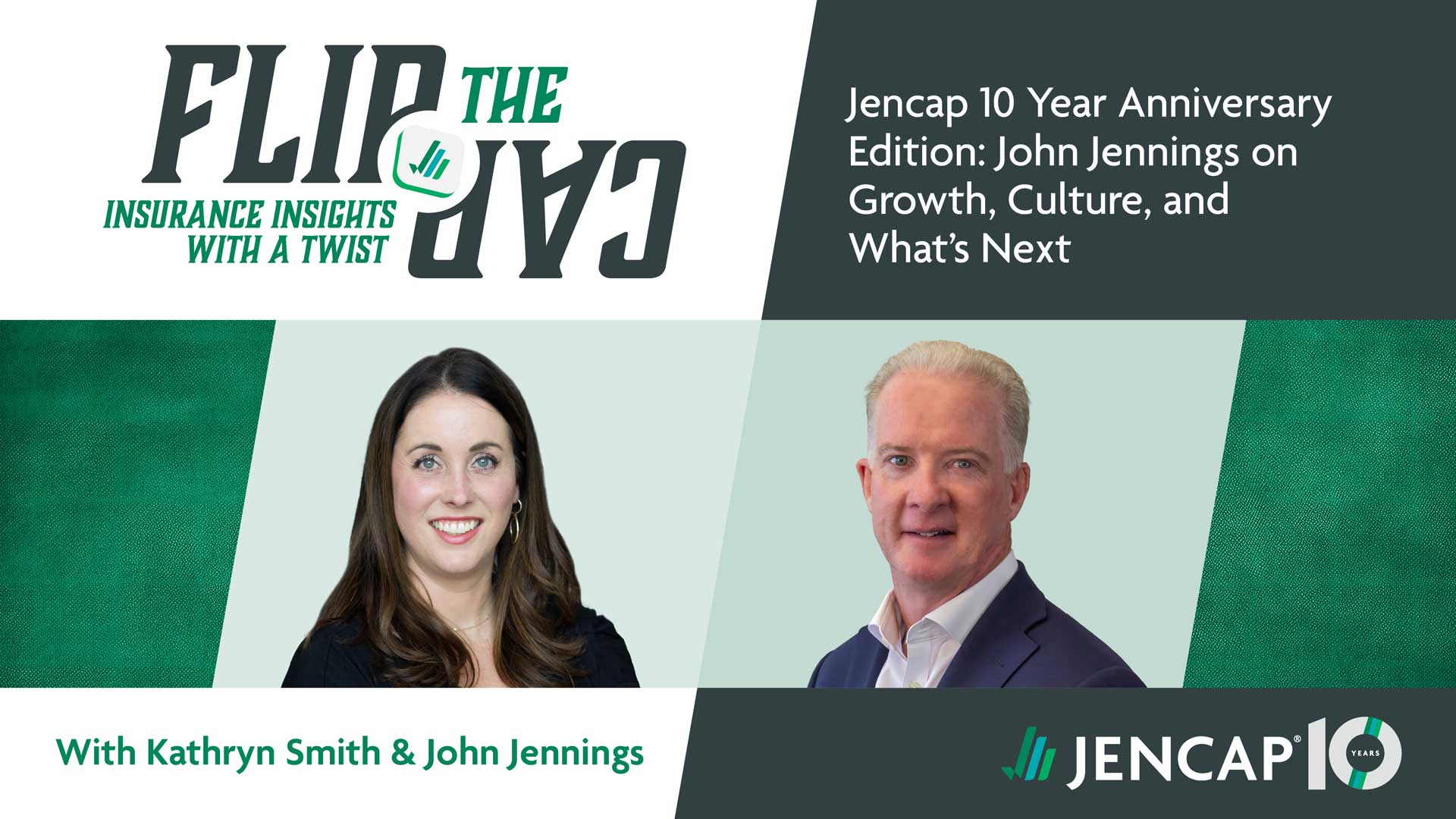
Flip the Cap Episode 22: Jencap 10 Year Anniversary Edition: John Jennings on Growth, Culture, and What’s Next

Apr 7, 2026
Flip the Cap Episode 21: Global E&S Trends, Emerging Risks and 2026 Predictions

Nov 12, 2025
Flip the Cap Episode 20: The Energy Pivot: What’s Here to Stay and What’s On the Way

Aug 27, 2025
Flip the Cap Episode 19: Cannabis Insurance Insights: Regulatory Shifts, Coverage Gaps & Expert Strategies

Jul 31, 2025
Flip the Cap Episode 18: The Big Build: Inside Construction Wrap-Up Programs

Apr 24, 2025
Flip the Cap Episode 17: Flames of Uncertainty: How Wildfires Are Shaping Insurance
Mar 20, 2025
Recent Posts
The Technology Signals Reshaping Transportation Risk in 2026

Apr 25, 2026
Cannabis Insurance in Newly Legalized States

Apr 14, 2026
Renewable Energy Risk Trends for Insurance Agents
Apr 9, 2026
Flip the Cap Episode 22: Jencap 10 Year Anniversary Edition: John Jennings on Growth, Culture, and What’s Next

Apr 7, 2026
Common Gaps in Watercraft & Yacht Insurance Coverage

Mar 26, 2026
PFAS Disposal Rules Shift Again
Mar 19, 2026